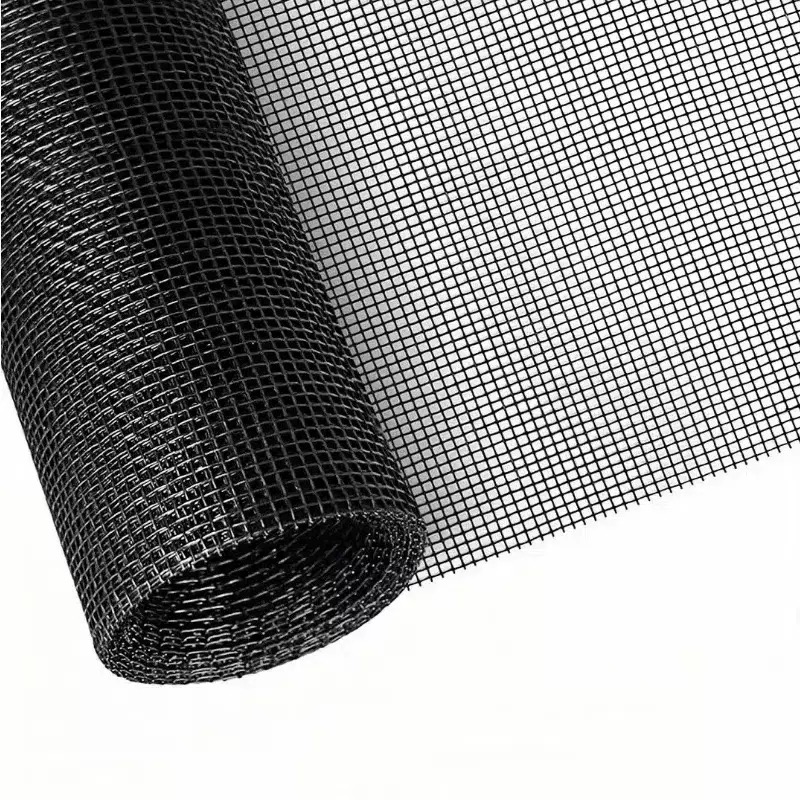
Short answer: screen mesh count is the number of openings per linear inch, counted in each of the weave’s two directions. 18×14 means roughly 18 openings in one direction and 14 in the other, per inch of screen. A higher count describes a tighter nominal weave. What the count does not tell you — on its own — is the finished opening size, airflow, visibility, strength or service life of a commercial screen. Those also depend on yarn diameter, material, coating and construction.
| Count | Nominal meaning | Common market position | What still needs verification |
|---|---|---|---|
| 18×14 | ~18 × 14 openings per inch | Pool & patio screen | Material, yarn diameter, roll width, opening |
| 18×16 | ~18 × 16 openings per inch | Standard fiberglass window & door insect screen | Yarn diameter, unit weight, roll format |
| 20×20 | ~20 × 20 openings per inch | Finer construction, commonly positioned for no-see-um conditions | Opening, airflow, visibility data, material |
What do the two numbers actually mean?
Screen mesh is woven in two perpendicular directions: the warp runs lengthwise along the roll and the weft runs across it. The count states how many openings (or yarns — the practical difference is small) appear per linear inch in each direction.
Three things follow from that definition:
- 18×14 is a directional count. The two numbers differ, so orientation can matter in fabrication.
- A higher second number means a tighter weave, assuming everything else stays equal. 20×20 is nominally denser than 18×16.
- The count is nominal. It identifies how the weave is counted, not how the finished product performs.
That last point is where most purchasing mistakes start. Two products with the same count can differ in yarn diameter, material, coating, unit weight and finished opening — and therefore in how they look, handle and perform.
Where standards fit in
Buyers who need a shared technical reference often anchor insect-screen specifications to ASTM D3656/D3656M — Standard Specification for Insect Screening and Louver Cloth Woven from Vinyl-Coated Glass Yarns. This is the product standard most commonly associated with vinyl-coated fiberglass insect screening, covering requirements for that product family.
Two practical notes when a standard appears in a specification or tender:
- The standard describes the product family, not one supplier’s roll. Conformance for a specific order is confirmed through the supply side’s own documents or testing — a question worth raising in the RFQ when the reference matters.
- Standards are family-specific. Solar screening woven from vinyl-coated fiberglass yarn, for instance, is covered by ASTM D4028/D4028M rather than D3656 — one more reason to name the exact reference document in the RFQ.
Source: ASTM International — D3656/D3656M · ASTM D4028/D4028M (solar screening)
How do you count mesh on an existing screen?
Screen manufacturer Phifer describes a practical method: cut a one-inch square from a piece of paper, lay it over the screen, and count the openings inside the square. Doing this in both weave directions gives you the two numbers.
Source: Phifer — Insect Screen FAQ
The method is approximate — counting a dense weave through a small paper window is easy to get slightly wrong — but it is usually enough to identify whether an unmarked roll is closer to 18×16 or 20×20. For a purchasing decision, confirm the count against a roll label, an old specification or supplier data rather than relying on one hand count.
If your roll still has its label, reading the label directly is faster and more reliable.
How do 18×14, 18×16 and 20×20 differ in the market?
18×14 is commonly positioned as pool and patio screen. Phifer lists its 18×14 fiberglass mesh for patio and pool enclosures, and wide roll widths are typical in that segment because large enclosures are screened with long, continuous panels.
Compare 18×14 with 18×16 · 18×14 vs 20×20
18×16 is a standard fiberglass window-and-door insect screen construction. Saint-Gobain ADFORS lists 18×16 as its standard fiberglass window screen count, and the confirmed roll example on this site is a black, PVC-coated 18×16 fiberglass screen.
Review the 18×16 Fiberglass Insect Screen
20×20 is a finer nominal weave. In the U.S. market it is commonly positioned as no-see-um screen — a construction intended for areas where tiny biting insects are a problem. Phifer’s screen selection guide groups finer fiberglass counts with that use case.
Not every count is close to square, by the way. Pet screens are commonly cataloged at counts like 12×12, 15×11 and 17×13, and pollen screens can run to directional counts such as 17×60. The same reading rule applies: the two numbers describe the weave, and everything else needs data.
Does a higher mesh count mean smaller holes?
Nominally, yes — more openings per inch means less space per opening, for the same yarn thickness.
The qualifier matters. The finished opening is what remains between the yarns after weaving, so a thicker yarn at the same count leaves a smaller opening, and a thinner yarn leaves a larger one. That is why opening-size tables published by individual companies describe their own products. An Australian window supplier, Meichen Windows, publishes indicative opening sizes for the counts it supplies, and its figures carry that product-specific caveat.
So the safe ordering is:
- mesh count tells you how the weave is counted;
- yarn diameter and finished opening tell you how open the screen actually is;
- sample or supplier data confirms what the specific product does.
What mesh count cannot tell you
A count on its own says nothing reliable about:
- finished opening size
- airflow
- visibility
- tensile, burst or tear strength
- insect exclusion for a specific insect species
- UV service life
- material — fiberglass, polyester and PP/PE all exist in similar counts
The same count in a different material family is a different product. 20×20 fiberglass, 20×20 polyester and 20×20 PP/PE share a nominal count but not a construction.
That is why a specification-led RFQ always pairs the count with material, coating, roll format and — where performance matters — current product data or a sample.
Where should you continue from here?
- 18×14 vs 18×16: differences, uses and how to choose — the pool-versus-window comparison
- 18×14 vs 20×20: pool screen vs no-see-um screen — the open-versus-fine comparison
- Fiberglass vs polyester screen mesh — the material-family comparison
- Why two 18×16 screens can still be different — when the same count is not the same product
- How to compare screen mesh quotations — normalizing quotes that share a count
- Browse fiberglass insect screen by count — from 16×14 up to 25×25
Quick FAQ
What does 18×16 mean on my roll label?
Eighteen openings per linear inch in one weave direction and sixteen in the other. It is the standard fiberglass window-and-door insect screen count in the U.S. market. The other label fields — material, coating, color and roll size — complete the specification.
Is a higher mesh count always better?
No. A higher count describes a denser nominal weave. Whether that is better depends on what the screen must do: exclude smaller insects, preserve airflow and view, handle correctly on the machine, or match an existing installation.
Does mesh count tell you the opening size?
Not by itself. The finished opening also depends on yarn diameter. Two 18×16 products with different yarns can have different openings.
Can I identify mesh count from a photo?
No. Photos of mesh do not carry a scale, and small count differences are hard to see. Read the label, check a specification, or use the paper-square counting method as a first approximation.
Ask about a specific count
If you have a count, a label, a photo or just an application, send what you have. The missing details can be clarified from there.